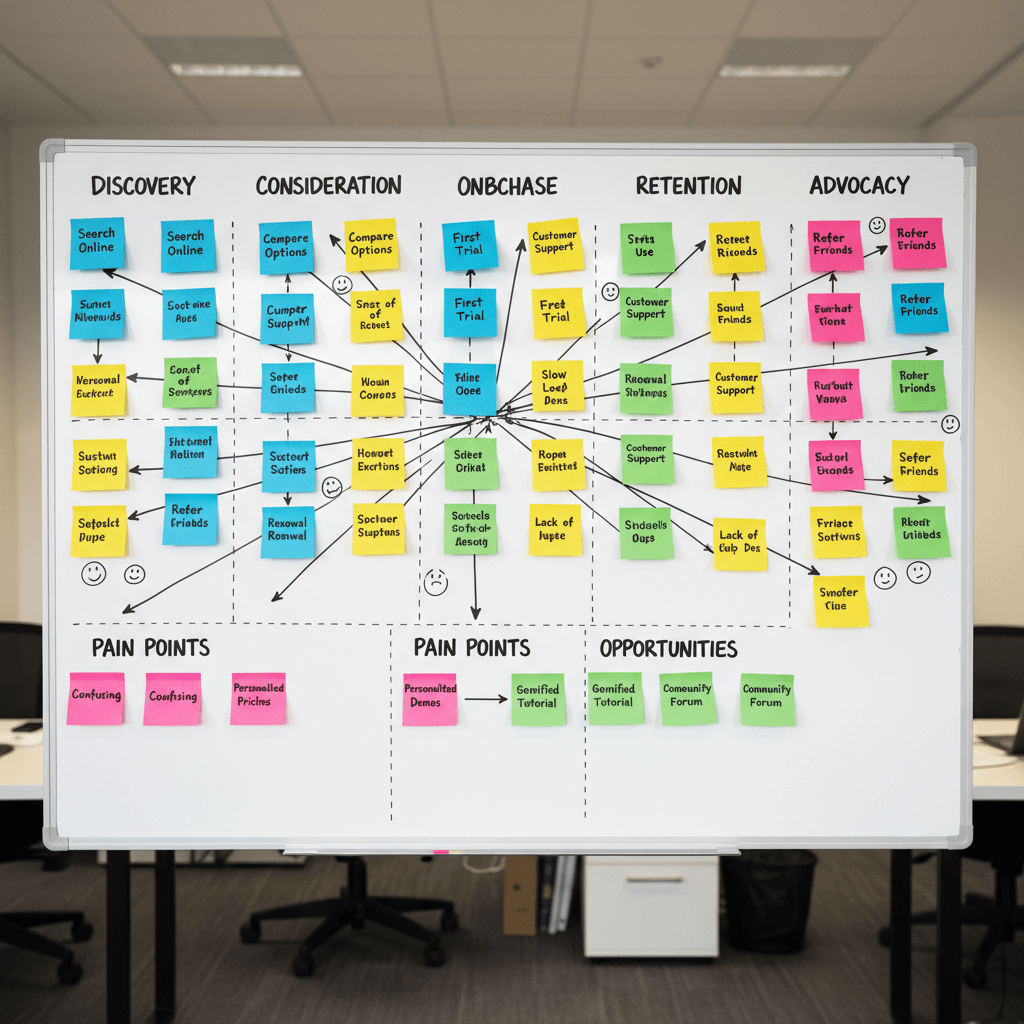

Effective customer experience fundamentals for small business center on managing the entire customer journey through strategic feedback loops, satisfaction monitoring, and consistent communication. While friendliness matters, true success requires a structured approach to solving problems quickly and optimizing every touchpoint from awareness to long-term retention.
Most small business owners mistake a friendly greeting for a comprehensive customer strategy. While being polite is essential, it rarely protects a brand from the operational friction that drives clients away. You might deliver an excellent product, yet still lose customers to a competitor who simply makes the purchasing process more predictable. This disconnect occurs when a business relies on personality rather than a structured framework. To scale effectively, you must move beyond reactive service and toward proactive experience design. In this guide, we will define the core pillars of customer experience for the solo entrepreneur, explore the three Cs of CX fundamentals, and provide a practical audit to identify service gaps. We will also examine how your local presence in Middletown shapes the customer journey; finally, we will identify cost effective tools to manage these systems without a corporate budget.
Defining Customer Experience for the Solo Entrepreneur
For the solo entrepreneur, customer experience is often misunderstood as a corporate term reserved for companies with massive data budgets and specialized analytics teams. In reality, customer experience fundamentals for small business are rooted in the human element rather than complex metrics. CX is the cumulative effect of every single touchpoint a client has with your brand. It begins with the initial Google search that leads them to your website, extends to the ease of your scheduling process, and continues long after the final invoice is paid.
Many owners conflate customer experience with customer service, but they are distinct concepts. While customer service is a specific, often reactive event, CX is the proactive design of the entire relationship. For a Middletown business owner, this experience is the literal foundation of your reputation in the community. It is the feeling a neighbor has when they interact with your digital presence and the lasting impression left after a project is complete.
Through comprehensive customer experience consulting, we help owners transition from simply being friendly to intentionally identifying service gaps that might be hindering growth. By viewing your business as a series of connected moments rather than isolated tasks, you can build a brand that resonates far beyond a single transaction.
Customer Experience vs Customer Service: Understanding the Difference

Mistaking a friendly demeanor for a comprehensive strategy is a common hurdle for many entrepreneurs. While being nice is a prerequisite for a Middletown business, it does not constitute a functional framework for growth. Customer service is a reactive event, typically triggered when a client needs a problem solved or a question answered. In contrast, customer experience is the proactive design of the entire customer journey. It is the difference between responding to a need and anticipating one.
For a shop owner on Central Avenue, customer service is the act of helping a visitor find a specific size or item on a shelf. It is a single, helpful interaction in a moment of need. Customer experience, however, encompasses the intuitive layout of the sales floor, the mobile responsiveness of the online booking system, and the emotional residue left after the transaction is complete. One is a localized task; the other is a holistic environment created by the brand.
Focusing on identifying service gaps allows you to see where the journey might be failing even when the face-to-face service is polite. An owner might be exceptionally kind, but if the digital checkout process is confusing or the follow-up communication is non-existent, the overall experience suffers. Mastering these customer experience fundamentals for small business requires looking at the architecture of your brand rather than just your social interactions. Through comprehensive customer experience consulting, we help owners transition from reactive troubleshooting to intentional journey mapping, ensuring that every touchpoint reinforces a professional and memorable brand presence.
The Three Cs of Customer Experience Fundamentals for Small Business
Building a functional framework for your brand requires moving beyond vague intentions and focusing on the Three Cs: Consistency, Communication, and Connection. These pillars form the core of customer experience fundamentals for small business, transforming a series of random interactions into a reliable journey.
Consistency is arguably the most difficult pillar for the solo entrepreneur to master. When one person wears every hat, from lead strategist to billing coordinator, the brand voice often fluctuates based on the owner's current stress level or workload. A client might experience a warm, detailed onboarding process but receive a curt, hurried response during the project’s peak. To combat this, you must institutionalize your brand voice. Develop templates for frequent touchpoints, such as inquiry replies or project updates, to ensure your professional standard remains stable even when your schedule is not.
Communication within a strategic CX framework is proactive rather than reactive. It involves setting clear expectations regarding timelines and deliverables before the customer has to ask. When communication is consistent, it builds the foundation for the third C: Connection. For entrepreneurs in Middletown, connection is a competitive advantage. It is the ability to remember a client’s specific goals or local ties, creating an emotional bond that big-box competitors cannot replicate.
At GFDG, our work centers on identifying service gaps within these three areas. We often find that a business has strong connections but lacks the communication systems to scale, or possesses great service that lacks consistency. Through comprehensive customer experience consulting, we help you build the infrastructure needed to maintain these fundamentals through every stage of your growth.
The Five Essential Components of a Small Business CX Strategy
Moving from the three pillars to a structural framework requires understanding the specific elements that dictate how a customer perceives your value. While enterprise models often use abstract metrics, a local strategy relies on five concrete components that define your brand’s daily reality.
The first component is the Physical and Digital Environment. This is the visual first impression, encompassing everything from the curb appeal of a storefront on Central Avenue to the mobile responsiveness of a website. It signals to the client whether you are attentive to detail or cutting corners. Next is Employee and Owner Engagement. For the solo entrepreneur, your personal energy is the brand. The enthusiasm, empathy, and responsiveness you bring to an initial consultation set the tone for the entire relationship.
The third element is Service Design, which refers to the intentionality of your internal processes. Through identifying service gaps, you can determine if your client onboarding is seamless or if friction points, such as confusing contracts or delayed invoices, are causing frustration. The fourth component is Product Quality. This is the baseline requirement; the final deliverable must consistently meet the expectations set during the sales process.
Finally, the most powerful component is Emotional Connection. This is where small firms in the Miami Valley hold a distinct advantage over national big box retailers. While a large corporation relies on automated scripts, a local owner can build genuine rapport based on shared community values and personal history. Cultivating this sense of belonging is a primary goal of comprehensive customer experience consulting. When these five elements align, they form the customer experience fundamentals for small business that turn a simple transaction into a long term partnership. By focusing on the human side of the interaction, you create a brand presence that is both professional and deeply personal.
Conducting a CX Audit: Identifying Gaps in Your Service Delivery

A strategy only works if you understand where the current structure is failing. This requires a formal gap analysis, a process dedicated to identifying service gaps by comparing your intended customer journey against the actual reality clients face. For many solo owners, the hardest part of this process is achieving total objectivity. You are often so immersed in the daily operations that friction points become invisible.
To start a self-led audit, you must physically and digitally retrace every step a customer takes. Consider these questions to pinpoint where the experience might be breaking down:
How many clicks or manual steps does it take for a new lead to book a consultation or complete a purchase?
How long does it take, on average, for a client to receive a response to an initial inquiry?
Is the transition between the digital experience and the physical meeting seamless in tone and quality?
Are there moments in the journey where the customer is left wondering what happens next?
While a self-audit is a vital first step in mastering customer experience fundamentals for small business, owners are frequently too close to their own work to see every flaw. Professional comprehensive customer experience consulting provides the outside perspective necessary to uncover deep-seated blind spots that hinder growth and reputation.
How Local Presence Impacts the Customer Journey in Middletown
The physical and social geography of Middletown introduces a unique layer to the customer journey. For Ohio entrepreneurs, the stakes are elevated because your brand exists where your customers live, work, and shop. While a local presence grants an initial layer of trust that national brands lack, it also means that service failures spread rapidly through word of mouth. This local dynamic changes the application of customer experience fundamentals for small business.
A memorable brand presence in the Miami Valley requires more than a storefront. It involves being active in the community and ensuring that every local touchpoint, from a sponsorship at a local event to a casual interaction on Central Avenue, aligns with your core values. When we work on identifying service gaps for local firms, we analyze how these community interactions influence the total journey. In a town like Middletown, your reputation is your most valuable asset; maintaining it requires a strategy that treats every neighborly interaction as a critical part of the professional experience.
Practical Tools for Managing CX Without a Corporate Budget

Managing the customer journey does not require a massive software subscription or an analytics department. While large corporations rely on complex dashboards, small business owners can master customer experience fundamentals for small business using tools they already own. The most effective way to gather feedback is through intentional, direct communication. A simple follow-up email sent forty-eight hours after a project closes provides data that assists in identifying service gaps without the need for expensive analytics software.
Likewise, encouraging clients to leave Google Reviews creates a public record of your reliability, which is essential for a Middletown brand. Do not overlook the power of casual conversations at the end of a transaction; asking 'What was the easiest part of working with us today?' often yields more actionable insight than a twenty question survey. The ultimate goal of these efforts is to transition a one-time buyer into a brand advocate who actively promotes your business. At GFDG, we provide the comprehensive customer experience consulting necessary to turn these simple feedback loops into a repeatable strategy for long term growth.
While warmth and a friendly smile are excellent starting points for any small business, they cannot replace a well-defined customer experience strategy. True growth happens when you align your operations with clear goals and consistent systems. If you find yourself wanting expert help to refine these processes, GroundFloor Development Group is here to support your journey. You can learn more about our team and approach to see how we help businesses scale through strategic planning. Building a better foundation starts with the right plan.