

Customer experience for small business is the strategic management of every customer interaction to foster loyalty and long term growth. Effective CX strategies increase revenue by driving repeat purchases and high value referrals; research shows that repeat customers spend up to 31 percent more than new ones. Prioritizing these relationships allows solo owners to build a sustainable growth engine that outperforms traditional acquisition methods.
For the solo business owner, the marketing cycle often feels like a constant race toward a moving finish line. You invest your limited time and capital into aggressive lead generation, yet you still struggle to build a stable foundation of recurring revenue and organic referrals. This disconnect occurs because traditional marketing only gets people through the door; it is your customer experience that keeps them there. At GroundFloor Development Group, we view CX as the most reliable engine for sustainable growth in a lean operation. In this guide, we will move beyond surface level service to explore the Three Cs of CX. You will learn how to identify specific service gaps, implement high impact tools for a one person department, and generate referrals that feel earned rather than requested.
Understanding Customer Experience for Small Business and Solo Owners
When global tech giants discuss customer experience, they often focus on high-level data points, cloud integrations, and complex software metrics. However, for a solo entrepreneur or a small business owner in Middletown, customer experience is far more visceral. It is the emotional residue left in a client's mind after every single interaction with your brand.
It is vital to distinguish between customer service and customer experience consulting. Customer service is a reactive component; it is how you handle a specific question or resolve a late shipment. Customer experience is the proactive, holistic journey. It begins the moment a potential client sees your first Instagram DM or a message in a local community group, and it continues long after the final invoice is paid. Every touchpoint contributes to your professional reputation, either reinforcing your value or creating friction.
Many local business owners mistake being friendly for having a customer experience strategy. While a pleasant demeanor is essential for building rapport, it is not a substitute for actionable strategies for growth. A true strategy ensures that the level of care and professional quality is identical whether you are at your desk on a Monday morning or finishing a project late on a Friday night. Without a documented approach, your brand reputation is left to chance. By viewing every touchpoint as a deliberate building block, you transition from simply providing a service to creating an enduring professional presence that earns trust and builds long term authority in the Miami Valley.
Why CX Outperforms Traditional Marketing in ROI
Transitioning from a general reputation to a focused strategy reveals the financial reality of running a lean operation. For many solo owners in Middletown, marketing budgets are tight. Spending money on lead generation is often a leaky bucket approach; you pour resources into getting people in the door, only for them to exit after one transaction because the experience was unremarkable. In contrast, prioritizing customer experience for small business creates a compounding interest effect.
Industry data shows that acquiring a new customer costs five times more than retaining an existing one. Furthermore, loyal clients are five times more likely to repurchase and seven times more likely to try a new service or offering. When a solo entrepreneur utilizes customer experience consulting to refine their delivery process, they turn a one-time buyer into a long-term advocate.
Marketing is essentially a recurring expense that stops producing results the moment the payment ends. A superior experience is an investment that builds brand equity over time. By implementing actionable strategies for growth that focus on the post-purchase journey, you stop the cycle of constant lead chasing. This shift allows you to stabilize your income through retention and referrals, turning satisfied clients into your most effective, unpaid sales team.
The Three Cs of Customer Experience for Small Business Owners

Building on the logic of CX as a high yield investment, successful solo owners anchor their operations in three fundamental pillars often called the Three Cs. These principles transform a general service into a professional brand that scales without losing its soul.
Consistency is the first requirement. For a local entrepreneur, a single lapse in quality can jeopardize a reputation built over years. Customers value predictability; they need to know that the experience they receive on a Tuesday morning is identical to the one they get on a Friday afternoon. Second, Competence addresses the core reason you were hired. No amount of charm can replace the need to solve a client's problem efficiently and effectively. True customer experience consulting requires that your technical skills are backed by streamlined processes that respect the client's time.
Finally, Connection serves as the solo owner's greatest superpower. While massive corporations spend millions trying to appear human, you actually are. Being the face of your business allows for a level of transparency and trust that no corporate entity can achieve. By integrating actionable strategies for growth with this personal touch, you create a bond that transcends a simple transaction. When you utilize CX audits to refine these three areas, your customer experience for small business moves from a series of tasks to a cohesive strategy that builds long term local authority.
Mapping the Solo Journey: Identifying Service Gaps
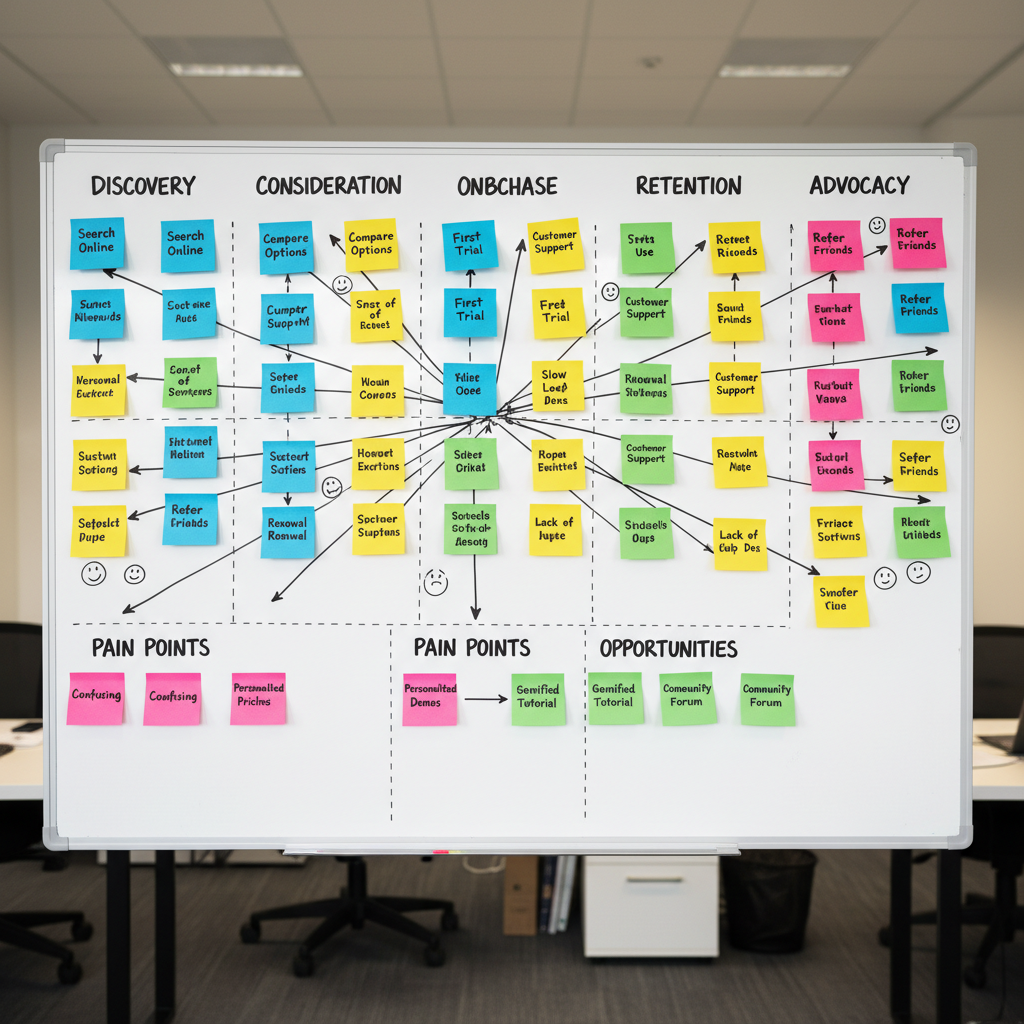
Customer journey mapping is the process of documenting every micro-interaction a client has with your brand, from the initial discovery to the final deliverable. To do this effectively, you must set aside your operational perspective and adopt the customer's viewpoint. For a Middletown entrepreneur, this means recognizing that different entry points carry unique emotional weights. A client who finds your services through a recommendation in a Middletown community Facebook group arrives with a degree of pre-established trust; conversely, a walk-in at a local workspace or storefront may be starting from a place of skepticism or immediate need. Each path requires a different level of initial nurturing.
Identifying service gaps requires a rigorous CX audit to pinpoint exactly where friction occurs. Research indicates that 33% of customers consider switching to a competitor after just one bad experience, which makes identifying these drop-off points a high priority for any solo owner. To conduct a basic gap analysis, list every step of your process and look for "silent" failures. Does a prospect wait forty-eight hours for a response to an inquiry? Is your onboarding sequence confusing or overly technical? These are the moments where customer experience for small business often falters.
By mapping these touchpoints, you can develop actionable strategies for growth that address these specific leaks. This objective look at your business helps you see where a client might feel neglected or overwhelmed. Once these gaps are visible, you can transition from reactive problem-solving to proactive journey design, ensuring that every interaction reinforces your professional authority rather than eroding it.
How to Generate Referrals Without Sounding Desperate
Once you have eliminated friction through mapping, the final stage of the journey transitions naturally into advocacy. Many Middletown entrepreneurs hesitate to ask for referrals because they fear looking transactional or needy. This hesitation often arises when referrals are viewed as a separate sales tactic rather than the natural byproduct of a high-value customer experience for small business. When you consistently deliver results, a referral is not a favor you are asking of the client; it is an extension of the value you have already provided.
Data supports this shift in perspective. The success rate of selling to an existing customer is 60-70%, whereas selling to a new prospect is only 5-20%. Because loyal clients are four times more likely to refer others, your referral strategy should be built into your actionable strategies for growth from the start. A highly effective method is the "intro over the referral" approach. Instead of asking for a list of names, ask for a simple introduction to one person who could benefit from a specific outcome you achieved together. This shifts the dynamic from a high-pressure request to a collaborative connection.
To maintain professional authority, implement follow-up email sequences that prioritize value over the ask. Rather than a generic request for leads, send a post-project resource, such as a maintenance checklist or a relevant industry insight, before mentioning referrals. This ensures the client’s final impression is centered on your expertise. By utilizing CX audits to refine these post-purchase touchpoints, you ensure that advocacy becomes a documented part of your business model rather than a happy accident.
Practical Tools for a One Person CX Department

Generating referrals through high-value interactions leads to a growing client list, which necessitates a system to manage these relationships without drowning in administrative tasks. Many solo owners search for enterprise-level customer experience software for small business, but complex platforms often create more work than they solve for a lean operation. A high-impact CX department of one only requires a few foundational tools: a basic CRM to track touchpoints, a simple automated feedback loop, and consistent branding fundamentals.
Instead of expensive suites, focus on a lean Customer Relationship Management (CRM) tool to document the "intro over referral" conversations and project milestones mentioned previously. Incorporating a post-project survey through a straightforward digital form allows you to gather the specific data points needed for CX audits. These small, repeatable systems transform your professional appearance from a disorganized freelancer to a structured brand that clients trust.
GFDG helps local entrepreneurs in the Miami Valley bridge the gap between winging it and operating with a documented strategy. Through customer experience consulting, we identify which lean tools fit your specific workflow and local context. By implementing these actionable strategies for growth, you ensure that your technology supports your personal connection with the client rather than getting in the way of it. This structured approach allows a solo owner to manage a sophisticated journey with the efficiency of a much larger team.
Moving from Service to Experience: The GFDG Approach
GFDG works specifically with Middletown entrepreneurs to bridge the divide between surviving and flourishing. Process focused customer experience consulting moves past high level theory into practical application through hands-on workshops and detailed CX audits. High quality customer experience for small business is not merely about fixing problems; it is centered on designing delights that build long term loyalty and local brand authority.
By identifying exactly where your service delivery can be elevated, we provide the actionable strategies for growth necessary to thrive in the Miami Valley. This shift transforms your professional presence from a simple service provider into a sought after expert that clients trust and recommend. Our approach ensures that every interaction reinforces your reputation, turning the challenge of being a solo owner into the advantage of delivering personal and superior value.