
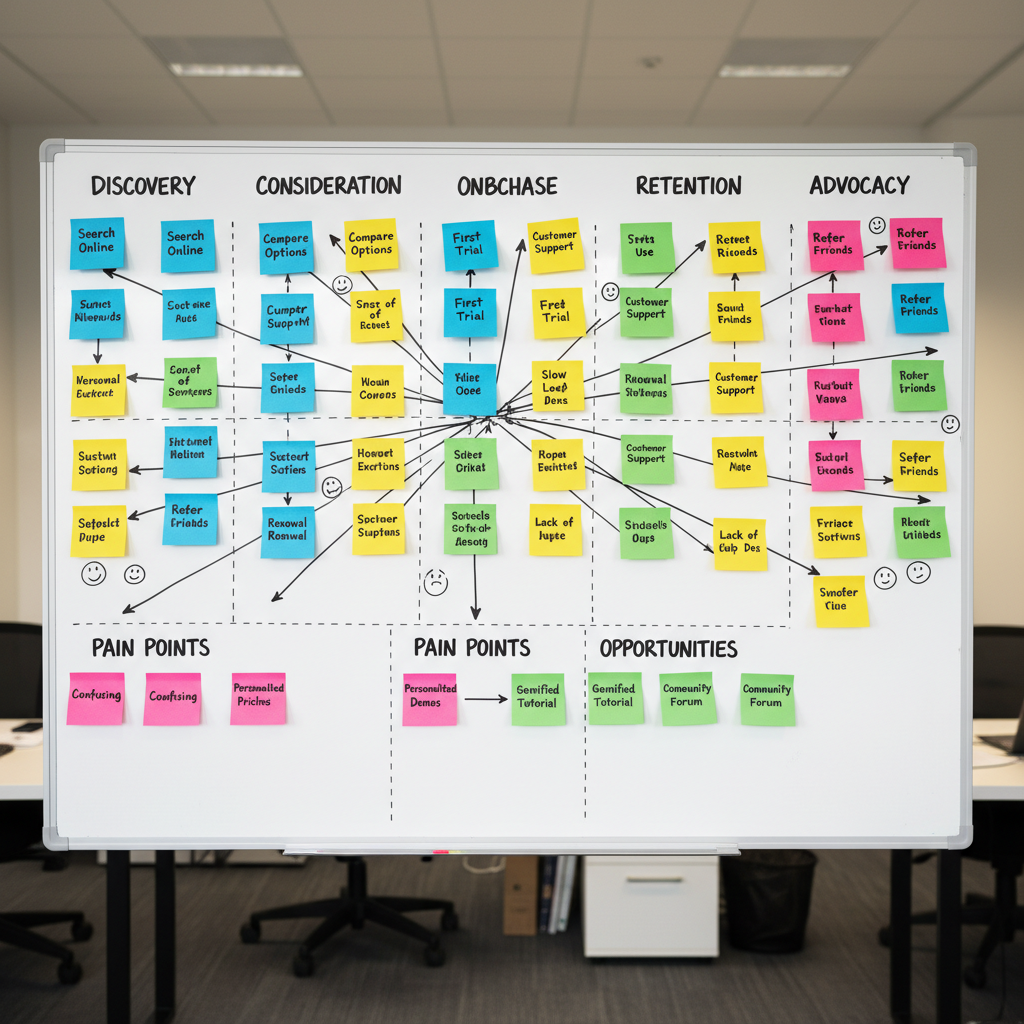
Customer journey mapping for small business is the process of creating a visual guide that tracks every interaction a client has with a brand, from initial discovery through post-purchase support. Solo owners use these maps to ensure brand consistency by identifying key touchpoints where they can deliver a cohesive message and improve the overall user experience. This strategic approach helps small businesses build trust and streamline their marketing efforts by seeing their services through the customer's eyes.
As a solo owner, you likely feel the exhausting weight of managing every interaction yourself while wondering why some leads vanish before the sale. It is frustrating to invest time into marketing only to realize your brand message feels fragmented across different platforms. This lack of alignment is more than a minor annoyance; it is a fundamental barrier to scaling your operations and building lasting trust. By mastering customer journey mapping, you bridge the gap between initial awareness and long term loyalty. In this guide, we will break down the five essential stages of the journey and identify critical touchpoints. You will learn a practical, step by step process to audit your brand consistency, specifically through the lens of our local Middletown business landscape, to ensure every customer experience feels intentional and professional.
What is Customer Journey Mapping for Small Business Owners?

Customer journey mapping for small business is far more than a technical exercise; it is the visual narrative of every single interaction a client has with your brand. While large corporations often rely on complex, expensive software to track data points, for a solo entrepreneur in Middletown, a journey map serves as a practical blueprint. It allows you to step outside your own operations and see the business through the customer’s eyes, from the very first moment they discover your logo to the final follow-up after a project is complete.
It is vital to distinguish a journey map from a traditional sales funnel. A funnel is primarily concerned with the mechanics of conversion and the movement of a lead toward a transaction. In contrast, a journey map prioritizes the emotional experience and the impact of specific brand touchpoints. It tracks how a person feels as they navigate your services. If your Instagram presence is energetic and approachable, but your invoice emails feel cold or overly bureaucratic, you are essentially switching personalities mid-stream. This inconsistency creates friction and can leave a customer feeling uncertain about their choice.
By identifying service gaps through mapping, you ensure that the person who meets you at a local community event finds that same professional voice when they visit your website or receive an automated receipt. This clarity helps you build a cohesive brand that works effectively even when you are not in the room. Through comprehensive customer experience consulting, solo owners can visualize these paths to ensure every touchpoint reinforces a singular, memorable brand identity.
Why Brand Consistency is the Secret to Small Business Growth

Trust is the primary currency for any entrepreneur in Middletown. At its core, brand consistency means providing a uniform experience across every channel your business occupies; it ensures that your digital footprint, physical presence, and verbal communication all share a single, recognizable identity. When a business feels fragmented, perhaps with a polished website but a chaotic email style, customers subconsciously get nervous. This lack of cohesion signals a lack of reliability, which can stall growth before a transaction even occurs.
Psychological research indicates that it typically takes seven touchpoints before a consumer feels enough confidence to move toward a purchase. In the context of customer journey mapping for small business, each of these interactions acts as a building block for trust. If your brand voice or visual style shifts during these seven moments, you force the customer to re-evaluate who you are, essentially resetting the clock on their confidence.
For a solo owner, consistency serves as a strategic asset that works for you even when you are not in the room. By identifying service gaps where your messaging might falter, you create a seamless path that converts strangers into loyal advocates. Participating in hands-on workshops can help you refine these touchpoints, ensuring your brand remains steady and professional as you scale your operations.
The 5 Key Stages of the Small Business Customer Journey
To build a map that actually drives results, you must first understand the five specific phases your clients navigate. Each stage presents a unique opportunity for customer journey mapping for small business to illuminate exactly where your brand is succeeding and where you might be losing momentum. These stages ensure your brand remains a constant, reassuring presence from the first point of contact to long after a project concludes.
Awareness: This is the discovery phase where a potential client first encounters your name. For a Middletown entrepreneur, this often happens through a post in a local community Facebook group, a referral from a fellow business owner, or a visible lawn sign. The goal here is simple visibility and establishing an initial, professional impression.
Consideration: During this stage, the prospect is actively evaluating your expertise against other options. They might spend time reviewing your portfolio, reading your Google reviews, or checking your LinkedIn profile to see if your style aligns with their needs. Identifying service gaps at this stage is critical; if your website is difficult to navigate or your bio is outdated, you risk losing the lead before they even reach out.
Purchase: This is the transaction phase where a prospect becomes a customer. For a solo owner, this often involves sending a digital invoice or a contract for signature. The experience must be frictionless and secure, reinforcing the professional standards you established during the awareness phase.
Usage: This stage covers the delivery of your service or product. It could be the first strategy session in a comprehensive customer experience consulting package or the moment a customer unboxes a physical product. This is where you fulfill your brand promise through direct action and high quality delivery.
Post-purchase (Loyalty): Often the most neglected stage, this involves the follow up after the work is done. A handwritten thank you note or a quick check-in email three weeks later can transform a one-time buyer into a lifelong advocate. Focusing on this phase through hands-on workshops helps solo owners develop systems for long term retention and referrals.
How to Identify Your Brand Touchpoints Across the Map
A brand touchpoint is any specific moment of contact where a customer interacts with your business. These moments are the building blocks of your reputation. For a solo entrepreneur, touchpoints are often the only way a client can gauge your professionalism before they ever meet you. Common touchpoints include your social media bios, invoice templates, email signatures, physical packaging, and voicemail greetings. Each of these should reflect the same brand voice and visual identity.
Using customer journey mapping for small business helps you uncover hidden touchpoints that are frequently neglected. These are the automated or routine interactions, such as the system-generated receipt email or the specific language you use when answering the phone. While these may seem minor, they are critical for removing friction and maintaining trust throughout the process.
By identifying service gaps in these micro-interactions, you ensure your brand feels cohesive rather than fragmented. A journey map serves as an audit tool, highlighting where a default template or a rushed response might be undermining your hard work. Our hands-on workshops provide the space to dissect these points, ensuring that every encounter, no matter how small, reinforces your commitment to quality and service.
Step by Step: Creating Your First Customer Journey Map
Creating your first map does not require a subscription to high-end analytics software. For most entrepreneurs, the most effective tool is a blank wall and a pack of sticky notes. This tactile, low-tech approach allows you to step away from the digital clutter and focus on the human experience. When we facilitate hands-on workshops, we use this method to help owners visualize their processes without the distraction of complex software interfaces.
Identify your target persona. Choose one specific segment of your audience, such as a local Middletown resident seeking specialized services. Mapping for a broad, generic audience often results in a map that lacks actionable depth.
List every point of contact. Gather every touchpoint, including your Google Business profile, your initial discovery call, and your final project invoice.
Plot these points on a timeline. Arrange your sticky notes from left to right across the five stages of the journey. This visual layout reveals exactly where your interactions are concentrated and where they are sparse.
Identify the emotional temperature. Below each touchpoint, note how the customer likely feels at that moment. Are they anxious during the pricing discussion? Are they relieved once they receive your welcome kit? This is a primary method for identifying service gaps where the customer may feel disconnected or unsupported.
Check for brand alignment. Review the entire map to ensure your professional voice remains consistent. If your brand feels authoritative during the awareness phase but timid in the post-purchase phase, you have identified a significant friction point.
Executing this process of customer journey mapping for small business provides a physical representation of your brand promise. It allows you to see where you are fulfilling your commitments and where you need to refine your approach to maintain a cohesive reputation.
Auditing Your Journey for Consistency: A Middletown Business Perspective

A static map is only a starting point; the real work begins when you step into the customer’s shoes to verify those touchpoints. To conduct an effective audit, you must become your own secret shopper. Start by signing up for your own newsletter using a personal email address. Observe the tone of the automated welcome message. Does it feel like the same person who just chatted with a neighbor at a Middletown community event, or does it feel like a generic corporate template?
Next, go through the actual process of purchasing your own product or booking a consultation. Pay close attention to the transition points. If someone meets you at a local event and finds you warm and approachable, your digital presence must echo that GroundFloor vibe. When your website feels formal and cold but your in-person style is relaxed, you create a brand fracture that confuses potential clients.
This audit is essential for identifying service gaps where your local charm might be getting lost in translation. Use this walkthrough to ensure your tone remains consistent from the first Google search to the final invoice. If you find the process reveals inconsistencies you cannot solve alone, comprehensive customer experience consulting provides the objective perspective needed to align your digital and physical worlds. Refining these details through customer journey mapping for small business ensures your brand remains a reliable, singular entity in the minds of your neighbors.
Common Mistakes in Journey Mapping and How to Avoid Them
Even with a thorough audit, many entrepreneurs fall into the trap of mapping the journey they wish customers took rather than the path they actually navigate. One of the most frequent errors in customer journey mapping for small business is documenting a sanitized, perfect version of the process. If your map ignores the confusing link in your social media bio or the three day delay in returning a voicemail, you are missing the real opportunity for identifying service gaps. Use your recent audit data to reflect the messy reality of the customer experience.
Another common mistake is treating the map as a static project rather than a living document. Solo owners often over-complicate the process with high-tech software, creating a file that is eventually forgotten. Furthermore, research suggests that owners frequently neglect the post-purchase phase, failing to map touchpoints for follow-up support or review requests. Through hands-on workshops or comprehensive customer experience consulting, you can ensure your map remains a practical tool that evolves alongside your Middletown business, turning one-time buyers into long-term advocates.
Mastering your customer journey is the most effective way to ensure brand consistency as a solo owner. By aligning every touchpoint with your core values, you create a reliable experience that builds lasting trust with your audience. While these strategies are powerful, implementing them effectively often takes time and a high level of technical precision. If you want expert help navigating these complexities or building a stronger brand, you can read more about our approach at GFDG. We are ready to help you streamline your path to success.